


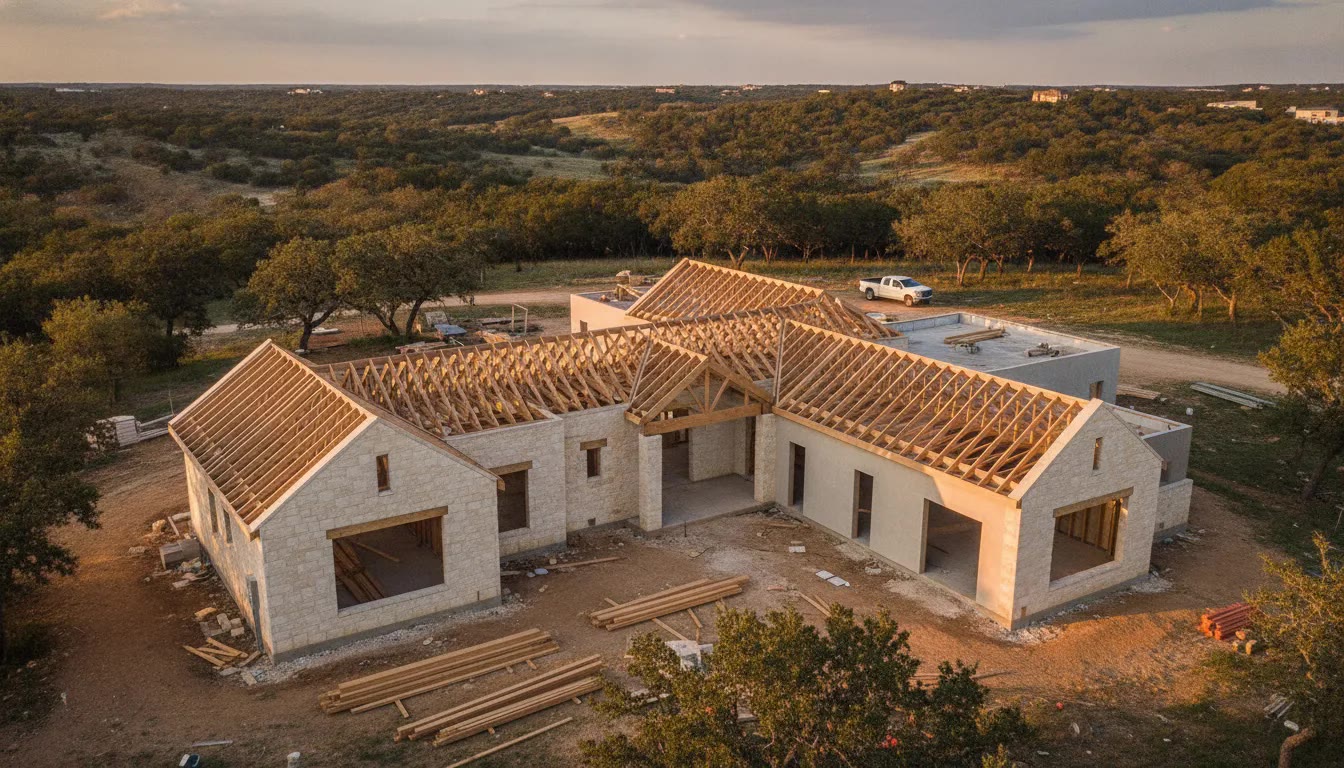
A construction loan interest reserve Texas custom home buyers ask about is money a lender may set aside to pay interest while the house is being built. It is not a discount, a builder fee, or a promise that you will owe nothing during construction. Some lenders include a reserve. Others expect you to pay interest yourself as funds are released. The loan documents, not a general rule, decide which one you have.
The Consumer Financial Protection Bureau describes a construction loan as short-term funding for building or rehabilitating a home. The money is usually released in a series of advances. Interest on those advances is separate from the hard costs of the house. A reserve is one way a lender may plan for that interest. Ask whether your file has one before you treat the monthly payment as settled.
Contact JLP Builders to discuss your home plans
What a construction loan interest reserve covers on a Texas custom home
During construction, the house is not finished and you are usually not living in it. The lender still charges interest on money it has already advanced for plans, site work, materials, and labor. An interest reserve is a portion of the loan the lender holds back for those interest charges instead of asking you to write a check each month.
Think of the loan in two piles. One pile pays the build. The other, if your lender uses it, pays interest on the first pile as it is drawn. You do not receive the reserve as cash at closing. The lender keeps it and applies it to interest according to the note.
That structure can make a long Hill Country build easier to cash-flow, especially if you are still paying for the home you live in now. It can also make the total loan larger, because the reserve is part of what you borrow. A larger loan can change the down payment, the appraisal, and what you still owe when the construction phase ends.
JLP Builders does not make loans and does not set interest terms. A lender decides whether a reserve is offered, how it is calculated, and what you must do if it is used up. Bring the builder's scope, timeline, and allowance list to that conversation so the lender is sizing the loan against the project you actually plan to build.
How a construction loan interest reserve may be funded
Lenders do not use one formula. These are patterns buyers in Texas commonly see. Your closing disclosure and note control.
| Approach | What the lender may do | What to confirm |
|---|---|---|
| Reserve inside the loan | Hold back part of the loan and apply it to interest as advances are made. | Is the reserve borrowed? Do unused funds reduce what you owe? |
| Interest paid by you each month | Bill interest on the outstanding balance, often with no reserve. | When is the first payment due? Does it rise after each advance? |
| Reserve you deposit at closing | Ask you to fund an interest account with your own cash. | Does that cash count toward the contribution the lender already wants? |
| Interest added to the balance | Add unpaid interest to the principal instead of collecting it monthly. | Is that allowed, and what does it do to the balance at conversion? |
A reserve inside the loan feels simpler month to month because you may not mail a payment. It is not free. You are borrowing the money that pays the interest, and you pay interest on borrowed funds that have been advanced. If the lender also charges interest on the undrawn reserve, that is a different and more expensive structure. Ask the question directly. Do not assume the reserve sits idle at no cost.
The Consumer Financial Protection Bureau notes that construction-loan payments sometimes start six to 24 months after the loan is made. You may then pay the balance in a lump sum or convert to a longer mortgage. A reserve is one reason a lender can delay out-of-pocket interest. It does not, by itself, tell you whether the loan converts automatically. It also does not tell you whether you must apply again for the permanent mortgage.
Why a reserve is not the same as a draw or a contingency
Three buckets get mixed together in construction financing, and mixing them leads to bad surprises.
Interest on money already advanced
Once the lender releases funds for a phase of the build, interest usually starts on that amount. If there is no reserve, you pay it. If there is a reserve, the lender may pay it from the reserve. Either way, the charge follows the money that has left the lender, not the full loan amount, unless your note says otherwise.
The draw itself
A draw is the release of construction funds after the lender's conditions are met. Draws pay the builder, trades, and suppliers. They are not the interest reserve. A slow inspection or a missing lien waiver can delay a draw. That delay can also change how fast the reserve is used, because interest keeps accruing on money already out.
A contingency for the build
A construction contingency is money for surprises in the project: rock, a longer utility run, a code change, or an allowance that comes in high. It is not an interest reserve. Spending the contingency on a site problem does not refill the interest reserve. Using the interest reserve to cover a site problem is usually not allowed, because the lender earmarked it for interest.
Ask the lender to label each bucket in the budget: hard costs, soft costs, contingency, and interest reserve. If the interest line is buried inside "soft costs" with no amount, you cannot tell whether the plan can carry the build you expect.
What can make a construction loan interest reserve run out
A reserve is a forecast. The lender estimates how much interest will accrue before the house is finished and the construction phase ends. The forecast can miss. When it misses, the reserve can hit zero while the house is still underway.
- A longer build. Weather, permit timing, material lead times, and change orders can push the schedule past the months the lender used. Interest keeps accruing on funds already advanced.
- A higher rate than the estimate. If the construction rate can adjust, a reserve sized at one rate may not cover a higher rate. Ask whether the estimate used today's rate or a higher stress rate.
- Faster draws than the model. Interest is often calculated on the outstanding balance. If large advances happen early, the balance, and the interest, grow sooner than a back-loaded schedule assumed.
- A rate that applies to more than the advances. Confirm that interest is charged only on funds disbursed, not on the unused reserve or the full commitment, unless you have agreed to something else.
- A pause you did not plan. A redesign, a survey correction, or a wait on a utility can stop visible progress without stopping interest.
If the reserve runs out, the usual result is that you start paying the interest out of pocket. Or the lender asks for more cash before it will keep advancing funds. Some lenders will consider increasing the loan. That is a new credit decision, not an automatic refill, and it can require a new appraisal or a new look at your debt.
This is why the construction calendar belongs in the lender meeting. JLP's custom home building process is the place to see how design, permits, and construction line up before a lender locks a month count. A reserve sized to a generic six-month guess is a weak fit for a custom home whose site work and finishes take longer.
Questions to ask before you rely on a reserve
You do not need to negotiate like a banker. You do need a short list you can take to two lenders and compare in writing. Qualification rules, reserve policies, and rate structures differ, including among lenders who all call the product a Texas construction loan.
- Does this loan include a construction loan interest reserve, or will I pay interest as funds are advanced?
- Is the reserve part of the amount I borrow, or is it cash I deposit?
- What rate, term, and draw timing did you use to size it? Did you add months for delay?
- Is interest charged only on funds that have been disbursed?
- Who tracks the remaining reserve, and will I get a statement each month?
- What happens the month the reserve reaches zero? Do draws stop until I pay?
- If the build runs long, can the reserve be increased, and is that a new approval?
- Does any unused reserve reduce my balance, come back to me, or disappear into the conversion?
- Does the construction loan convert to a permanent mortgage on its own, or do I apply again?
- Which fees sit outside the reserve, including inspections, extensions, and rate-lock costs?
Write the answers next to each other. A lower rate with no reserve can cost more each month than a slightly higher rate that carries the interest until completion. A reserve that looks generous can still fail if it assumes a shorter build than your lot and plan require.
Bring the same project facts to every lender: the lot, whether you already own it, the plan, the allowance summary, and a realistic duration. If you are still choosing land, say so. A loan sized before the lot is known often has to be resized, and the reserve has to be resized with it.
How the reserve fits a custom build, not a finished house
A construction loan interest reserve for a Texas custom home sits in a different cash picture than a mortgage on a finished house. You may still be paying housing where you live. You may be funding a lot you already own, or buying one. You may be waiting on a septic design, a driveway, or a water plan before the slab can start. None of that is the reserve, but all of it can stretch the months the reserve has to cover.
The pre-construction stage is where many of those months hide. Selections, engineering, and permits happen before the first large construction advance, and some lenders start the construction clock earlier than buyers expect. Ask when interest starts: at closing, at the first draw, or at a date in the note.
If you already own the lot, ask whether any equity in that land can count toward the cash the lender wants in the deal. That is a contribution question, not an interest-reserve question, but it changes how much cash you have left to cover interest if the reserve is thin. The path from lot purchase to move-in is a useful checklist so the lender's month count matches the work in front of you.
Plan choices matter for the same reason. A larger or more complex plan can lengthen construction and raise the balance on which interest accrues. Looking through Texas Hill Country floor plans with a budget conversation, not only a style conversation, keeps the reserve discussion tied to a real house.
JLP coordinates the construction side: scope, schedule, and the documents a lender asks the builder to provide. JLP does not quote interest, approve a reserve, or tell you which loan to take. If a lender needs a cost breakdown or a draw schedule, that request comes back through the builder. The interest math stays with the lender.
What to line up before the lender meeting
A reserve conversation goes better when the project is specific. These are the items that change the estimate. They are not a loan application.
- The lot status. Owned, under contract, or still shopping. Lenders treat those three differently.
- A duration you believe. Include design, permitting, and a cushion. A best-case month count makes a reserve look finer than it is.
- The cost categories. Separate site work, the house, allowances, and a construction contingency from the interest line.
- Your monthly housing now. If you must carry your current home plus construction interest, say so. A reserve may matter more in that case, and the lender needs to see the payment either way.
- What "done" means. Ask which event ends the construction phase: a final inspection, a certificate of occupancy, or a conversion date. The reserve should be aimed at that event, not at a guess.
The things to settle before you build in the Hill Country cover lot, design, and builder questions that sit beside financing. Use them so the lender meeting is about the reserve, not about facts you have not decided.
Avoid treating any online calculator as your number. Published examples from other states, other property types, or investor projects use different timelines and different rates. A custom home on your lot needs the lender's worksheet, with your rate and your schedule, before you rely on it.
A simple way to compare two lender answers
When two lenders both say yes, compare the interest plan, not the headline rate alone.
- Write down whether each one uses a reserve, a monthly interest payment, or interest added to the balance.
- Write down the dollar amount of any reserve and the number of months it is meant to cover.
- Ask both what you would pay in a month when half the loan is drawn, and in a month when the reserve is gone.
- Ask what cash you must still hold back for living expenses and for a construction contingency that is separate from interest.
- Ask what changes if the build takes three months longer than the term they used.
You are looking for a plan you can live with if the schedule slips, not for the smallest number on a good day. A reserve that is slightly larger than the lender's base case is often easier to understand than a thin reserve plus a hope that nothing moves.
None of this is a quote. JLP's pricing for a custom home is set per project, and lenders set their own rates and terms. This article cannot tell you what your interest will be. It can help you ask the questions that keep the interest plan visible before you start.
Ready to get a custom quote? Contact JLP Builders
Frequently Asked Questions
What is a construction loan interest reserve?
It is an amount a lender may set aside to pay interest during construction. Some lenders include it in the loan. Others do not offer one and expect you to pay interest as money is advanced. The note and closing documents say which applies to you.
Does every Texas custom home construction loan include one?
No. Reserve policies differ by lender and by loan program. Two buyers with similar houses can have different structures. Ask each lender whether a reserve is included, how it is funded, and what you pay if it is not.
Is an interest reserve the same as a down payment?
No. A down payment or equity contribution is cash or land value the lender wants in the project. An interest reserve, when it is borrowed, is part of the loan used to cover interest. A deposit you make into an interest account is your cash, and you should ask whether it counts toward the contribution the lender already requires.
What happens if the reserve runs out before the house is finished?
You should expect to pay interest yourself, and the lender may pause advances until that payment is arranged. Increasing the reserve is a new decision by the lender, not something the builder can authorize. Ask about this before closing, including whether a longer schedule would require a new approval.
Can JLP Builders set up or guarantee the reserve?
No. JLP Builders is the builder, not the lender. JLP can provide plans, a scope, and construction documents a lender requests. The lender decides eligibility, the rate, whether a reserve exists, and what happens if construction takes longer than planned.