


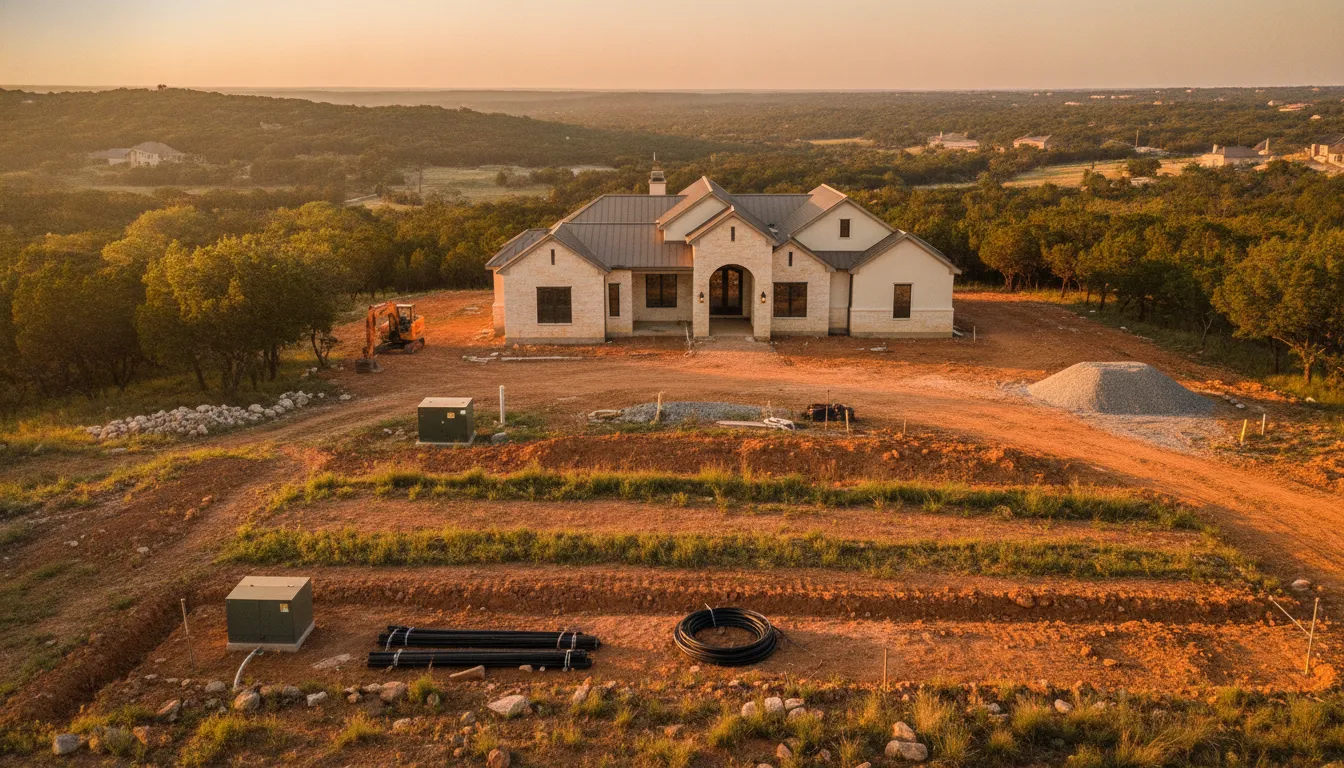
Hidden costs when building a custom home in Texas aren’t always unexpected fees. Often, they come from items that weren’t included in the original construction scope, allowances that don’t fully cover your selections, or site conditions that can only be determined after your property is evaluated. In the Texas Hill Country, understanding these potential costs early can help you build a more realistic budget and know exactly what to ask before signing a contract.
Talk with JLP Builders about your custom-home scope
The goal is not to predict one universal cost. It is to make every assumption visible before you sign. Ask what is included, what is excluded, and what may change.
What are hidden costs when building a custom home in Texas?
A hidden cost is an expense that is not obvious from a headline base price. It may be assigned to the homeowner, included only as an allowance, or triggered by a site condition or personal choice. The same line item can be included in one builder's proposal and excluded from another, so comparing totals without comparing scopes can create a false sense of certainty.
For a Texas Hill Country build, review these five questions before treating a price presentation as a complete budget:
- Does the scope include the lot work needed to place and access the home?
- Which permits, inspections, tap fees, utility connections, and jurisdictional charges are included?
- Which fixtures, appliances, surfaces, and exterior items are allowances rather than final selections?
- What happens when an allowance is too low or a requested change affects labor and schedule?
- Does complete mean move-in ready, or does it stop at the house and leave driveway, landscaping, fencing, or other work to the owner?
These questions turn a broad estimate into a scope audit. They also help distinguish a legitimate site-specific adjustment from a cost that was simply left unclear.
Site development costs that may sit outside the base contract
Land is one of the biggest reasons two apparently similar custom homes can require different scopes. A lot may need a boundary survey, topographic information, geotechnical review, clearing, tree work, rock excavation, grading, drainage work, retaining features, or a construction access route. None of those conditions can be responsibly priced from the home plan alone.
Before signing, ask the builder to explain which site investigations have been completed and which are still assumptions. Request a written list showing whether the following are included, excluded, or pending:
- Boundary, topographic, or tree surveys.
- Soil, geotechnical, foundation, or rock-related review.
- Clearing, haul-off, tree removal, excavation, fill, and compaction.
- Driveway access for construction equipment and the finished driveway surface.
- Drainage, grading, erosion control, culverts, retaining walls, and site restoration.
- Temporary construction access, fencing, dumpsters, and utility access during the build.
Texas Hill Country terrain can vary substantially from one parcel to another. A site visit and written assumptions are more useful than a generic allowance.
For a broader sequence from land purchase through move-in, see this custom home building timeline. Use it as a companion resource, not as a substitute for a site-specific scope.
County permitting, inspections, and utility connection fees
For a Texas custom-home proposal, permitting and utility costs are hidden when the responsible party, connection point, or approval fee is not written into the scope. Before signing, match each permit, inspection, water, wastewater, electrical, and access assumption to a document, owner, and confirmation date.
Use a simple scope matrix when reviewing the proposal. It helps separate a confirmed inclusion from an allowance or an item that still needs a site-specific answer.
| Cost area | Question to ask | Document to request |
|---|---|---|
| Site work | Is clearing, rock, grading, drainage, and access included? | Site report and written exclusions |
| Utilities | Where is each connection point, and who pays for the extension? | Utility notes and provider requirements |
| Selections | Which products are upgrades, and what is included? | Included Features and Additional Features |
| Completion | Does complete include driveway, landscaping, fencing, and appliances? | Scope sheet and completion checklist |
| Changes | How are price and schedule impacts approved? | Change-order procedure |
Permitting and utility responsibilities depend on the property's jurisdiction and existing infrastructure. A rural or semi-rural lot may require different planning than a serviced lot in a subdivision. The contract should make clear who prepares applications, who pays official fees, and which inspections or approvals are part of the builder's service.
Ask specifically about:
- Building permits, plan review, and required inspections.
- Municipal, county, HOA, or architectural control committee review.
- Water availability, tap or connection charges, meters, and private wells.
- Wastewater options, septic evaluation, design, permitting, and installation responsibilities.
- Electrical service, transformer or extension requirements, trenching, and final connection.
- Gas, propane, internet, drainage, and other services that may not be at the property line.
Do not assume that a utility being available nearby means the connection is included. Ask for the connection point, the responsible party, and the assumption behind the price. For construction sites that disturb regulated amounts of soil, the Texas Commission on Environmental Quality explains construction stormwater requirements and the applicable general permit at TCEQ's construction stormwater page. The exact requirement for a property should be confirmed with the appropriate professionals and jurisdiction.
HOA or ACC review can also affect plans, materials, engineering, and timing. Request the governing documents and approval path early. A contract that identifies approval responsibilities is less likely to leave a buyer guessing after design work has started.
Which interior and completion choices create surprise costs?
Selections are a common source of budget movement because a base specification may describe a category without describing the final product. Cabinets, counters, flooring, lighting, plumbing fixtures, appliances, doors, hardware, windows, fireplaces, and built-ins can all be allowance-based or subject to an upgrade decision.
For each selection category, ask for four details:
- What product, level, quantity, or performance standard is included?
- Where and when will the selection be made?
- What happens if the chosen item costs more or requires different installation?
- Can a change affect other trades, the schedule, or the completion date?
Completion scope deserves the same attention. A buyer may think of a home as complete while the proposal stops at the structure and interior. Confirm the treatment of appliances, window coverings, landscaping, irrigation, fencing, mailbox work, pool or outdoor living features, driveway finish, final cleaning, and moving-related preparation. These items are not automatically included or excluded across every contract, so the written scope controls.
JLP's before-building guide for Texas Hill Country can help organize early questions about land, design, and the building process. Keep the questions specific to your parcel and your selections.
How JLP Builders makes scope and budget questions visible
A transparent process does not mean every project has the same price or that every site condition can be known in advance. It means the builder gives the buyer a clear path for identifying assumptions, confirming decisions, and documenting changes.
JLP Builders describes a process that includes preliminary meetings, a site visit and home-placement review for Build On Your Lot projects, a preliminary price presentation, and pre-construction checkpoints. Those checkpoints can include lender appraisal review, HOA or ACC plan and engineering approval, a construction-loan closing, and a pre-construction meeting when applicable. The exact requirements depend on the project and property.
JLP also uses a 17-point inspection system, customer survey touchpoints, and web-based project tracking as part of its quality and communication approach. These systems do not guarantee that a project will have no changes. They provide a framework for surfacing questions during the build instead of waiting until the final walk-through.
Review the JLP custom home process and ask how its stages connect to your own scope. If you already own land, confirm how site findings, utilities, selections, and allowances will appear in the proposal. If you are considering a turnkey path, ask which land and home assumptions are included in the initial conversation and which are confirmed later.
What should you ask a custom home builder before signing?
Use this short checklist in your next builder meeting. Ask for direct answers in the proposal, contract, allowance schedule, or written scope rather than relying on a conversation alone.
- What work is included from the property line through the finished home?
- Which surveys, engineering reviews, tests, and site preparations are complete?
- What assumptions have been made about rock, grading, drainage, access, and foundation conditions?
- Who handles permits, inspections, HOA or ACC approvals, and official fees?
- Where are water, wastewater, electrical, gas, and communications connections located?
- Which finish, appliance, and exterior items are included or upgrades?
- What is the selection deadline, and what happens if an item is changed afterward?
- Which completion items are not part of the contract?
- How are change orders approved, priced, and tracked?
- What document will show the current scope and price after each approved change?
After the meeting, compare the answers with the proposal line by line. If an item is important to your move-in plan, it should have a clear inclusion, exclusion, allowance, or responsible party.
Ready to review your custom-home scope with JLP Builders?
Frequently Asked Questions
What are the hidden costs associated with building a house?
Common categories include site surveys and preparation, rock or grading work, drainage, permits, inspections, utility connections, HOA or ACC requirements, allowance differences, upgrades, change orders, driveway work, landscaping, fencing, appliances, and other completion items. The applicable items depend on the property and the contract. Ask for a written inclusion and exclusion schedule before signing.
What should I ask about a Texas Hill Country lot?
Ask whether the lot has been reviewed for access, topography, drainage, soil or rock conditions, utilities, wastewater, water service, and jurisdictional approvals. Confirm which investigations are complete and which remain assumptions. A site visit and written site-development scope are more useful than a generic statement that the lot is buildable.
Can a builder guarantee there will be no hidden costs?
No responsible builder can know every site condition or selection decision in advance. A better standard is transparency: define the scope, identify assumptions, document allowances, explain the change-order process, and confirm decisions at each stage. This helps buyers manage uncertainty without treating every project as identical.
Contact JLP Builders to start a clear custom-home conversation